
Resume guide
Resume Action Verbs: A Practical List (and How to Use Them)
Strong bullet points start with strong verbs. Here's a categorised list, plus the part most lists skip: how to actually use them so your bullets show impact, not just activity.
Why the first word matters
A recruiter skims the left edge of your bullet points first. If every line starts with 'Responsible for' or 'Worked on', they all blur together and none of them land. Starting with a precise past-tense verb does two things: it signals you took action, and it forces the rest of the sentence to describe what actually happened.
Verbs that show you led
- Led
- Directed
- Coordinated
- Oversaw
- Mentored
- Chaired
- Spearheaded
- Mobilised
Verbs that show you built or shipped
- Built
- Designed
- Developed
- Launched
- Shipped
- Engineered
- Created
- Implemented
Verbs that show you improved something
- Improved
- Increased
- Reduced
- Streamlined
- Optimised
- Accelerated
- Cut
- Automated
Verbs that show you analysed or solved
- Analysed
- Diagnosed
- Investigated
- Resolved
- Forecast
- Modelled
- Audited
- Evaluated
Verbs that show you persuaded or sold
- Negotiated
- Secured
- Closed
- Won
- Pitched
- Influenced
- Partnered
- Persuaded
The part most lists skip: pair the verb with a result
A strong verb on its own isn't enough. 'Optimised the checkout flow' is better than 'worked on checkout', but it still doesn't say what happened. Add the outcome:
- Verb only: 'Optimised the checkout flow.'
- Verb + result: 'Optimised the checkout flow, lifting completed orders 14%.'
- Verb only: 'Automated the weekly report.'
- Verb + result: 'Automated the weekly report, saving the team about 6 hours a week.'
Words to retire
Some phrasings quietly weaken every bullet they touch. Replace them:
- 'Responsible for' -> name the action: led, ran, owned, built.
- 'Helped with' -> say what you specifically did.
- 'Worked on' -> the vaguest two words on most resumes; be concrete.
- 'Duties included' -> a duty list isn't an accomplishment list.
Don't repeat the same verb
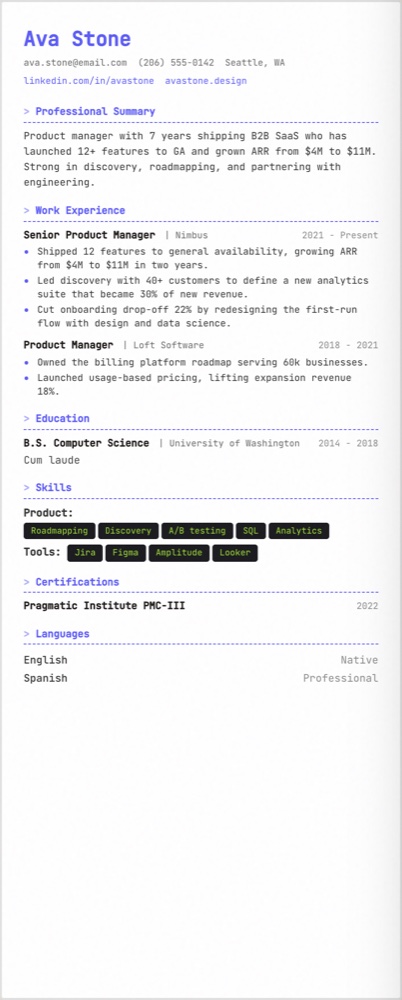
If three bullets in a row start with 'Managed', the repetition flattens them. Vary your verbs across a section so each accomplishment feels distinct. A builder that shows your whole resume at once makes this easy to spot.
See it come together
Floati's free builder includes a bullet-point helper that flags weak openings like 'Responsible for' and suggests stronger phrasings, plus live ATS scoring and clean PDF export, no account needed.
Frequently asked questions
Should every bullet start with a verb?
For experience and project bullets, yes. It's the clearest, most scannable structure and it pushes you to describe action rather than duty.
Past or present tense?
Past tense for previous roles and finished work. Present tense is fine for responsibilities in your current role. Keep it consistent within each job.
Can I reuse the same action verb?
Occasionally, but try not to repeat a verb within the same section. Variety keeps each accomplishment feeling distinct.
Do action verbs help with ATS?
Indirectly. ATS systems search for skills and keywords, not verbs, but strong verbs lead to clearer, result-focused bullets that read better to the human who sees you after the search.
Build your resume, free
A live ATS score, 12 recruiter-ready templates, and instant PDF export. No sign-up, no watermark.
Open the resume builder