
Resume guide
How to Write a Resume (Step by Step, 2026)
A resume has one job: get you to the interview. This walks through how to structure one, what belongs in each section, and how to write bullet points a recruiter actually finishes reading.
Start with the structure, not the words
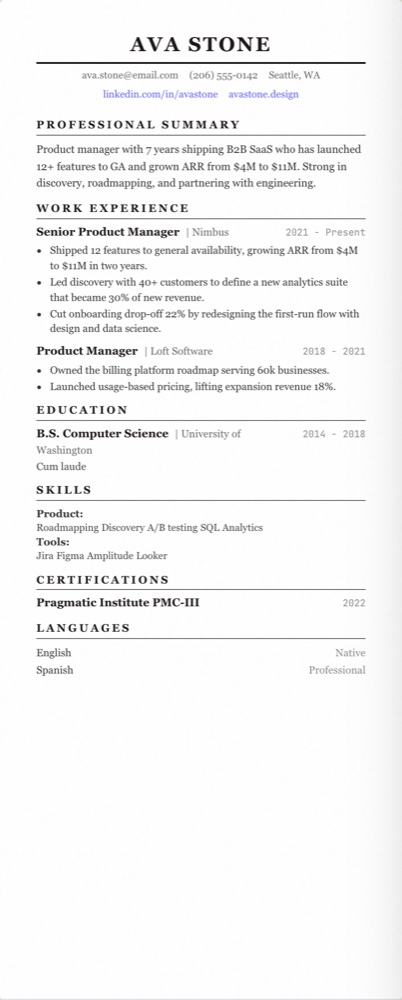
Most people open a blank document and freeze. Don't write prose first. Decide the skeleton, then fill it. A resume that gets interviews almost always has the same bones: a contact header, a short summary, work experience in reverse-chronological order, education, and a skills block. Everything else (projects, certifications, languages, volunteering) is optional and only earns its place if it makes you a stronger candidate for the specific role.
Reverse-chronological order is the default for a reason: recruiters read top-to-bottom and want your most recent, most relevant work first. Unless you're early-career or changing fields, lead with experience, not skills.
The contact header
Keep it to one line of identity and one line of contact. Full name, then a professional email, phone, city and country, and a LinkedIn or portfolio URL. Skip your full street address, your date of birth, and a photo unless the norm in your country and industry expects one. Every line here is a line not spent on your experience.
Write the summary last
A summary is two or three sentences at the top that tell the reader who you are and what you're good at. It is the hardest part to write well, so write it after everything else, when you can see your own strongest points. Name your role, your years of experience, and one or two concrete results. Cut every adjective that could appear on anyone's resume: 'hard-working', 'detail-oriented', 'team player' say nothing.
Make every bullet point earn its line
This is where resumes are won or lost. A weak bullet describes a duty. A strong bullet describes a result. Start with a past-tense action verb, say what you did, and where you can, attach a number: a percentage, an amount, a count, a timeframe. Numbers are the fastest way to turn a claim into evidence.
- Weak: 'Responsible for managing the company social media accounts.'
- Stronger: 'Grew Instagram following from 2,000 to 18,000 in 9 months by shipping a daily content calendar.'
- Weak: 'Worked on improving website performance.'
- Stronger: 'Cut page load time 40% by lazy-loading images and removing three blocking scripts.'
You will not have a number for every line, and that's fine. But if none of your bullets have numbers, recruiters have nothing concrete to remember you by.
Tailor it to the job
A generic resume sent to fifty jobs performs worse than a tailored one sent to ten. You don't rewrite from scratch each time. You read the job description, find the skills and tools it names, and make sure the ones you genuinely have appear in your resume in the same words. Applicant tracking systems and human readers both scan for the language of the posting.
- Paste the job description next to your resume.
- Highlight the skills, tools, and responsibilities it repeats.
- Confirm the ones you actually have are present, in plain words, in your experience or skills section.
- Reorder your bullets so the most relevant ones sit first.
Keep it to one page (usually)
If you have under ten years of experience, aim for one page. Two pages are acceptable for senior or highly technical roles where the depth is real. Three pages is almost never read in full. Length is not a measure of accomplishment; editing is. Cut the oldest, least relevant roles to bullet headlines or drop them entirely.
Proofread like it matters, because it does
A single typo on a resume reads as carelessness, fairly or not. Read it aloud, run a spellchecker, and have one other person look at it. Check that your tenses are consistent: present tense for your current job, past tense for everything else. Check that dates line up and don't contradict each other.
Then build it without fighting formatting
Once the content is right, the layout should be the easy part. A resume builder handles spacing, alignment, fonts, and PDF export so you spend your time on the words, not on wrestling with tab stops. Floati's builder is free, runs in your browser, scores your resume against ATS rules as you type, and exports a clean PDF with no sign-up and no watermark.
Frequently asked questions
How long should a resume be?
One page if you have under ten years of experience. Two pages is reasonable for senior or deeply technical roles. Past two pages, most of it goes unread.
Should I include a photo?
In the US, UK, Canada and Australia, no, leave it off; it invites bias and wastes space. In parts of Europe, Asia, and Latin America a photo is expected. Follow the norm where you're applying.
Do I need a different resume for every job?
You don't rewrite it each time, but you should tailor it: mirror the skills and language of each job description and reorder your bullets so the most relevant sit first.
What's the most common resume mistake?
Listing duties instead of results. 'Responsible for X' tells a recruiter nothing; 'Did X, which produced Y' gives them a reason to call you.
Build your resume, free
A live ATS score, 12 recruiter-ready templates, and instant PDF export. No sign-up, no watermark.
Open the resume builder