
Resume guide
How to Write a Resume With No Experience
Everyone's first resume is written with no work history. The trick isn't inventing experience, it's showing that what you have done (school, projects, volunteering, part-time work) maps to what the job needs.
"No experience" is rarely true
When a job asks for experience and you have no full-time roles, it's easy to conclude you have nothing to put down. You almost always do. Coursework, class projects, a capstone, an internship, a summer job, volunteering, a club you ran, a side project you shipped: all of it is evidence of skills an employer cares about. The task is not to fabricate a career, it's to present what you've actually done in the language of the role you want.
Lead with education, then flip the usual order
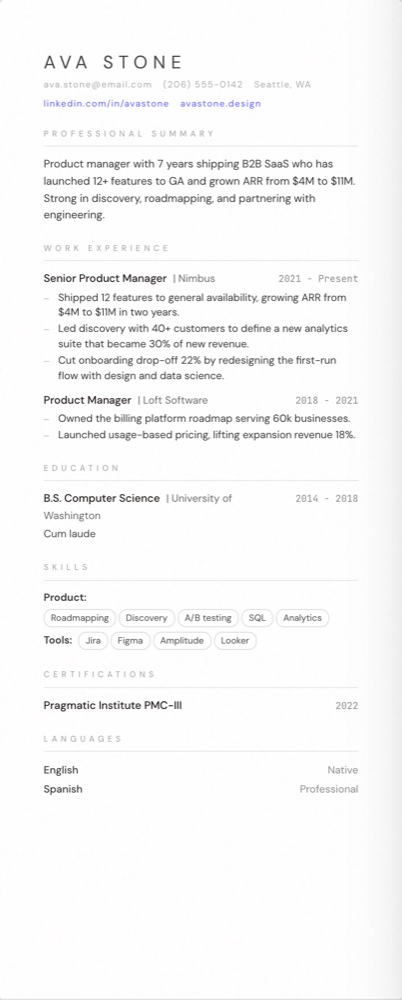
An experienced candidate leads with work history. When you're early-career, put education near the top and let projects and skills carry more weight. A sensible order for a first resume is: contact header, a short summary, education, then projects or relevant experience, then skills. If you have any paid work at all, even unrelated, include it; showing up reliably and being trusted with responsibility counts.
Turn projects into experience
A project section is where a resume with no jobs earns its interviews. Treat each project like a job entry: a title, one line of context, and two or three bullet points that say what you built, the tools you used, and the outcome. A class assignment you actually finished is more convincing than a list of technologies you've 'studied'.
- Weak: 'Made a website for a class.'
- Stronger: 'Built a 5-page course-catalog site in HTML, CSS and JavaScript; added client-side search that filters 300 courses instantly.'
- Weak: 'Did a group data project.'
- Stronger: 'Analyzed 12 months of city bike-share data in Python and pandas; found that 60% of trips clustered in three stations and presented the finding to the class.'
Name your transferable skills, with proof
Transferable skills are the ones that move between contexts: communication, teamwork, organization, problem-solving. On their own they're empty ('great communicator' means nothing). Tie each to something you did. 'Trained six new baristas during a summer job' shows leadership and communication without needing to claim either as an adjective.
Write a summary that sets expectations honestly
A first-resume summary should say who you are, what you're studying or trained in, and what you're looking for, in two or three plain sentences. You don't need years of experience to sound clear. 'Final-year computer science student with a strong Python foundation and two shipped web projects, looking for a junior developer or internship role' tells a recruiter exactly where you fit.
Keep it to one page and make it easy to scan
A first resume should be one page, always. Use a clean, single-column layout so an applicant tracking system parses it correctly and a human can scan it in seconds. Consistent dates, one font, generous white space. The content is modest by definition, so the presentation should be effortless to read.
Then build it in minutes
Once you know what goes where, the layout shouldn't cost you an evening. Floati's builder is free, runs in your browser, checks your resume against ATS rules as you type, and exports a clean one-page PDF with no sign-up and no watermark, which is exactly what a first resume needs.
Frequently asked questions
What do I put on a resume with no work experience?
Education, projects (class, personal, or capstone), any volunteering, clubs or leadership roles, and a focused skills list. Present projects like jobs: what you built, the tools, and the result.
Should I include a GPA?
Include it if it's strong (roughly 3.5+ / first-class) or if you're applying to a field that expects it. Otherwise leave it off and use the space for a project.
How long should a first resume be?
One page. With no work history there's no reason to spill onto a second, and padding to fill space is obvious to a recruiter.
Do I need a cover letter too?
It helps when you have little experience, because it's where you explain your motivation and connect your projects to the role. Keep it to three short paragraphs.
Build your resume, free
A live ATS score, 12 recruiter-ready templates, and instant PDF export. No sign-up, no watermark.
Open the resume builder